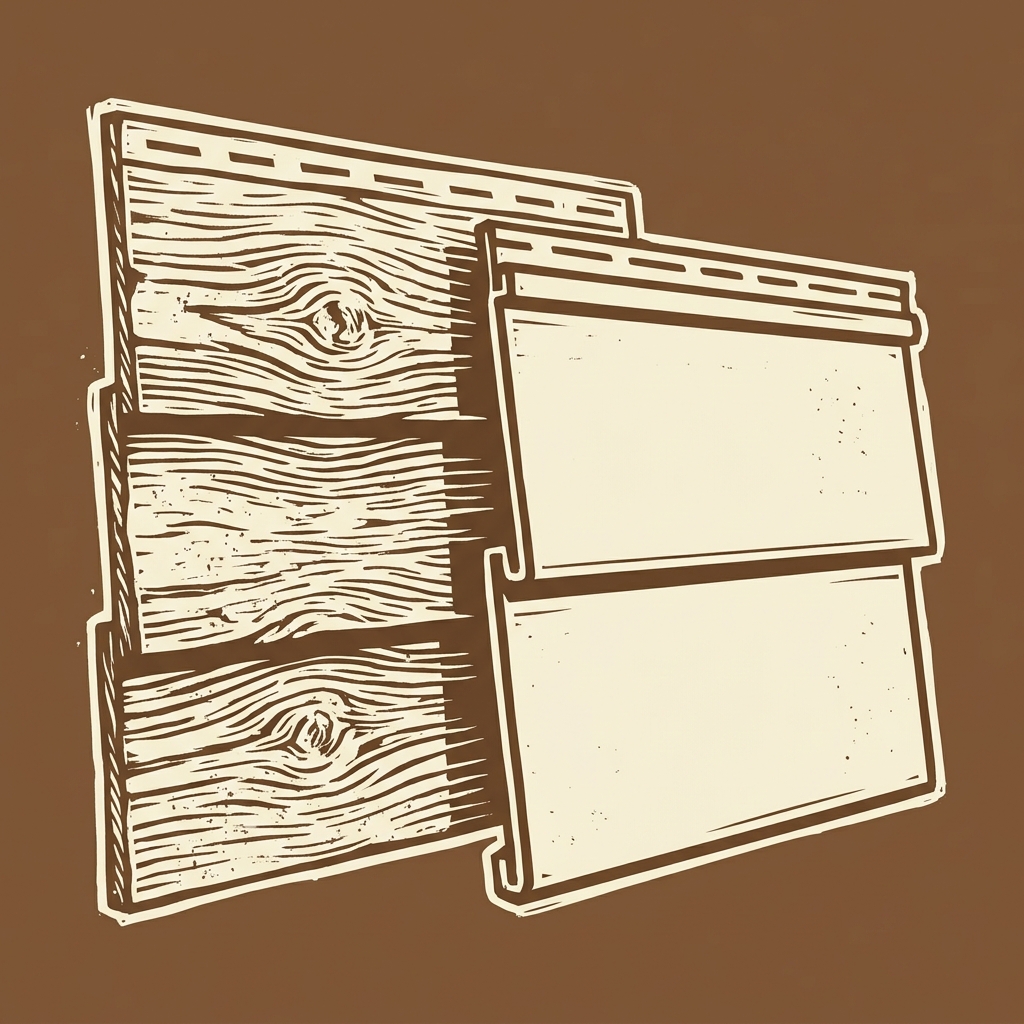
This is the most common cladding decision in American homebuilding — and one of the few where the cheaper option upfront usually stays cheaper over time. What flips the answer is your climate zone and your fire risk. Here are the real numbers.
The Core Difference Between Fiber Cement and Vinyl Siding
Fiber cement siding — the category dominated by James Hardie’s HardiePlank — is made from a mixture of Portland cement, sand, and cellulose fiber. It’s heavy (around 2.5 lbs per sq ft), dimensionally stable in most climates, and virtually impervious to rot, insects, and fire. It requires painting, either from the factory (Hardie’s ColorPlus technology) or on-site, and it needs to be repainted every 10–15 years depending on climate and paint quality.
Vinyl siding is extruded PVC, color-molded all the way through the material. It requires no painting, expands and contracts significantly with temperature changes, and is vulnerable to impact damage and UV degradation over time. It’s lighter (around 0.7–1.2 lbs per sq ft depending on thickness), faster to install, and considerably cheaper both to buy and to put up.
LP SmartSide, an engineered wood composite product, often gets compared to both. It’s worth knowing about: it sits between vinyl and fiber cement in cost, installs more like wood, and performs well in most climates. It’s included in the comparison table below.
| Feature | Fiber Cement (HardiePlank) | Vinyl Siding | LP SmartSide |
|---|---|---|---|
| Material cost per sq ft | $1.50–$2.50 | $0.90–$1.80 | $1.20–$2.00 |
| Installed cost per sq ft | $5.00–$10.00 | $3.00–$6.50 | $4.50–$8.00 |
| Paint required | Yes (or factory finish) | No | Yes |
| Impact resistance | Excellent | Poor–Moderate | Good |
| Fire resistance | Class A (non-combustible) | Melts/distorts | Class A (treated) |
| Insect resistance | Excellent | Excellent | Good (with treatment) |
| Moisture resistance | Excellent if sealed | Excellent | Good if maintained |
| Typical warranty | 30 years (James Hardie) | 20–50 years (varies) | 50 years |
| Climate zone suitability | All zones | Best in zones 3–6 | All zones |
Installed costs in 2026 vary significantly by region. Labor is the dominant variable — fiber cement is heavier and requires more skilled labor to cut and fasten correctly, which is why the installation gap between fiber cement and vinyl is wider in high-labor-cost markets (Northeast, West Coast) than in the South and Midwest.
The Real Cost Comparison Over 20 Years
Installation cost is only part of the picture. For a 2,000 sq ft home (~1,500 sq ft of siding coverage), here’s the 20-year total:
| Vinyl (0.044“ mid-grade) | Fiber Cement (HardiePlank ColorPlus) | |
|---|---|---|
| Installation | $4,500–$9,750 | $7,500–$15,000 |
| Repainting (yr 12–15) | Not needed | $2,500–$5,000 |
| Other maintenance | $500–$1,500 | $300–$800 |
| 20-year total | $5,000–$11,250 | $10,300–$20,800 |
On pure numbers, vinyl costs less over 20 years in most scenarios. The case for fiber cement rests on three things: resale value, climate performance, and fire resistance. In high-wildfire-risk areas (California, Colorado, Oregon, parts of Texas), fiber cement’s Class A fire rating is not just a preference — many jurisdictions and homeowner insurance policies now require or strongly incentivize non-combustible cladding. In those markets, fiber cement often pays back its cost premium in lower insurance premiums alone.
Climate Zone Guidance: Which Siding Wins Where
Vinyl siding’s biggest weakness is thermal expansion and contraction. PVC moves significantly between a Minnesota January (−20°F) and a Minnesota July (+95°F) — a differential that can cause panels to buckle, gap, or pull away from fasteners over time if not installed with proper spacing. Vinyl siding installed correctly with appropriate expansion gaps performs acceptably in most climates, but in climate zones 6, 7, and 8 (northern tier), the expansion issue is more pronounced, and the UV degradation from intense summer sun accelerates color fading.
Fiber cement, by contrast, is dimensionally very stable. It doesn’t expand and contract like vinyl, and it holds paint well in freeze-thaw cycles. In climate zones 1 and 2 (Florida, South Texas, Gulf Coast), the primary concern is moisture and humidity — fiber cement’s cement-based core resists moisture very well as long as the bottom edges are properly sealed and painted and are kept at least 6 inches above finished grade per manufacturer requirements. Failure to maintain proper clearance and sealing voids the James Hardie warranty and leads to the moisture intrusion problems that give fiber cement a bad reputation in wet climates.
Quick regional guide:
- Climate zones 1–2 (Southeast, Gulf Coast): Either works well. Vinyl has no UV or heat issues at these latitudes. Fiber cement holds up excellently if properly installed. Budget often decides.
- Climate zones 3–5 (mid-Atlantic, Midwest, mid-South): Both perform well. This is vinyl’s sweet spot — temperate climates with moderate temperature swings.
- Climate zones 6–8 (upper Midwest, Northeast, mountain states): Fiber cement or LP SmartSide is the stronger long-term choice. Vinyl’s expansion issues and brittleness in extreme cold make it less reliable.
- Wildfire interface zones (West): Fiber cement is the clear choice and often the only code-compliant option.
Vinyl Siding Thickness: Why It Actually Matters
Not all vinyl siding is created equal, and the difference between a budget installation and a quality one often comes down to panel thickness. Vinyl siding is measured in thousandths of an inch:
- 0.040" — Builder-grade, the thinnest widely sold. Noticeable flex underhand, limited impact resistance, prone to waviness if not installed perfectly.
- 0.044"–0.046" — Standard residential grade. Noticeably more rigid, better impact resistance, more forgiving of minor installation imperfections.
- 0.048"–0.055" — Premium grade. Significantly stiffer, best impact resistance in the vinyl category, closest to the appearance of wood or fiber cement.
If you’re going with vinyl, don’t go below 0.044". The cost difference between 0.040" and 0.046" material is typically $0.15–$0.30 per sq ft — a rounding error in the context of a full siding job. The performance difference is real and visible ten years later.
Frequently Asked Questions
Is fiber cement siding worth the extra cost over vinyl?
It depends heavily on your climate zone and how long you plan to stay in the home. In wildfire zones, high-wind coastal areas, or climate zones 6–8, fiber cement’s durability advantages make the cost premium worthwhile. In temperate climates (zones 3–5) where resale value matters and you’re planning to sell within 10–15 years, the premium for fiber cement can be recovered in appraisal value. If you’re building a primary residence you plan to own for 30+ years, fiber cement is almost always the better long-term investment.
What is the installed cost of James Hardie HardiePlank siding in 2026?
Expect $5.00–$10.00 per sq ft installed for James Hardie HardiePlank, including labor, flashing, and trim. The 2026 national average is approximately $7.00–$8.50 per sq ft for a straightforward single-story home. Costs are higher in the Northeast, Pacific Coast, and major metro areas where labor rates are elevated. Complex rooflines, two-story homes, and jobs requiring extensive trim work push costs toward the upper end of the range.
What thickness vinyl siding should I use for new construction?
For new construction, don’t go below 0.044" panel thickness. Standard residential installs use 0.044"–0.046", which offers good rigidity and impact resistance. If you’re in a hail-prone area (Great Plains, Midwest) or simply want a higher-quality finished appearance, 0.048"–0.055" premium-grade vinyl is worth the modest additional cost. Thicker panels also tend to hold their profile better over time, reducing the visible waviness that makes budget vinyl siding look cheap within a few years.
How does LP SmartSide compare to fiber cement and vinyl?
LP SmartSide is an engineered wood composite that sits between vinyl and fiber cement in price, performance, and installation difficulty. It installs similarly to wood (nailed, caulked, painted), costs $4.50–$8.00 per sq ft installed, and carries a 50-year warranty. It’s a strong choice if you want the look of wood siding without the maintenance of real wood, and it performs well in most climate zones. Its one weakness relative to fiber cement is that it’s not non-combustible — it carries a Class A fire rating through surface treatment, not inherently. In wildfire zones, check local code before specifying it.
Does fiber cement siding require painting and how often?
Factory-finished fiber cement (James Hardie ColorPlus) comes pre-painted and is warranted for 15 years against peeling, cracking, and chipping. Field-painted fiber cement typically needs repainting every 10–15 years depending on climate, paint quality, and sun exposure. South- and west-facing walls in high-UV climates (Southwest, mountain states) will need attention first. When repainting, use a high-quality 100% acrylic exterior paint and follow manufacturer prep requirements — improper surface preparation is the primary cause of premature paint failure on fiber cement.
What are the best siding options for coastal homes?
For homes within a mile of saltwater, fiber cement is the clear winner. It resists salt air corrosion, doesn’t rust, and holds up well in the high humidity and wind-driven rain common to coastal environments. Make sure all fasteners are stainless steel or hot-dipped galvanized — standard galvanized fasteners corrode rapidly in salt air environments and will cause streaking and panel failure within a few years. LP SmartSide is also acceptable in coastal zones with careful installation and maintenance. Vinyl siding is not ideal near saltwater — UV degradation is accelerated in coastal sun, and the expansion issues in temperature-extreme coastal climates reduce its longevity.