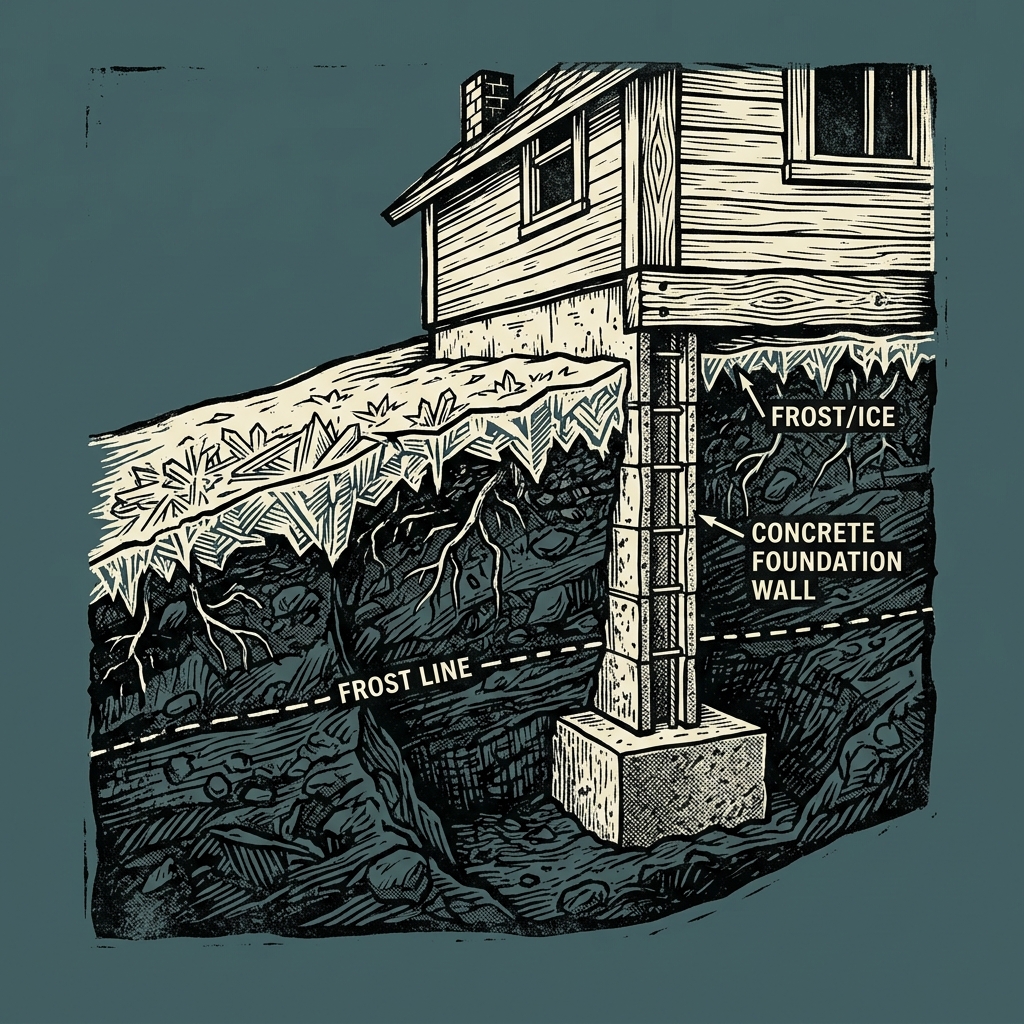
Get footing depth wrong and the ground itself will lift your foundation — heaved slabs, cracked walls, failed inspections. The required depth varies from 6 inches to over 100 depending on where you build. Here’s the state-by-state chart plus the code rules behind it.
Why Frost Line Depth Controls Everything Below Grade
The frost line — also called the frost depth — is the maximum depth at which groundwater in the soil is expected to freeze during a normal winter. Per the International Residential Code (IRC) Section R403.1.4, the bottom of all exterior footings must be placed below the frost line to prevent frost heave. Frost heave happens when water in the soil freezes, expands, and pushes upward — if your footing sits above that freezing zone, the ground will literally lift your foundation.
The IRC doesn’t publish a single national frost line number. Instead, it refers builders to the local frost depth map published by the American Society of Civil Engineers (ASCE) and requires local jurisdictions to set their own minimum. That means your county building department has the final word — not a general chart, and not this article. That said, state-level averages give you a reliable working target to design around before you pull permits.
Frost Line Depth by State: The Working Chart
Use these figures as your design baseline. Confirm the exact depth with your county building department before setting forms.
| State | Frost Depth (inches) | Notes |
|---|---|---|
| Alabama | 6 | Mostly frost-free; footings still required |
| Alaska | 60–100+ | Varies dramatically; Fairbanks exceeds 100“ |
| Arizona | 6–18 | Northern AZ (Flagstaff) significantly deeper |
| Arkansas | 6 | Low risk; confirm in northern counties |
| California | 12–24 | Mountain counties (Tahoe, Mammoth) up to 36“ |
| Colorado | 36–42 | Higher elevations add 10–15“ |
| Connecticut | 42–48 | Full New England depth |
| Delaware | 30 | Mid-Atlantic standard |
| Florida | 0–12 | No frost line in most of state; 12“ structurally |
| Georgia | 6–12 | Northern GA mountains: 18“ |
| Idaho | 36–48 | Northern Idaho similar to Montana |
| Illinois | 36–42 | Chicago: confirm at 42“ |
| Indiana | 36 | Standard Midwest |
| Iowa | 42 | Northern Iowa: 48“ |
| Kansas | 24–30 | Panhandle: 36“ |
| Kentucky | 18–24 | Eastern KY mountains: 30“ |
| Louisiana | 0–6 | Essentially no frost risk |
| Maine | 48–60 | One of the deepest in the lower 48 |
| Maryland | 30–36 | Western MD mountains: 42“ |
| Massachusetts | 42–48 | Full New England depth |
| Michigan | 42–48 | Upper Peninsula: 60“ |
| Minnesota | 42–60 | Northern MN approaches Alaska levels |
| Mississippi | 6 | Very low risk |
| Missouri | 24–30 | Kansas City area: 30“ |
| Montana | 42–60 | Varies significantly by elevation |
| Nebraska | 36–42 | Panhandle: 42“ |
| Nevada | 18–30 | Northern NV: 36“ |
| New Hampshire | 48–60 | Full northern New England depth |
| New Jersey | 36–42 | Northern NJ: 42“ |
| New Mexico | 18–24 | Northern NM mountains: 36“ |
| New York | 36–48 | NYC: 36“; Adirondacks: 60“ |
| North Carolina | 12–18 | Western NC mountains: 24“ |
| North Dakota | 60 | One of the highest in the contiguous US |
| Ohio | 36–42 | Northern OH lake effect: 42“ |
| Oklahoma | 12–18 | Panhandle: 24“ |
| Oregon | 12–24 | Eastern OR: 30–36“ |
| Pennsylvania | 36–42 | Western PA: 42“ |
| Rhode Island | 42 | — |
| South Carolina | 6–12 | Upstate SC: 18“ |
| South Dakota | 48–60 | Similar to North Dakota in north |
| Tennessee | 12–18 | East TN mountains: 24“ |
| Texas | 6–12 | Panhandle: 24“; Gulf Coast: 0“ |
| Utah | 30–36 | Higher elevations: 48“ |
| Vermont | 48–60 | One of the deepest in the lower 48 |
| Virginia | 18–24 | Western VA mountains: 30“ |
| Washington | 12–24 | Eastern WA: 30–36“ |
| West Virginia | 24–30 | Mountain counties: 36“ |
| Wisconsin | 42–60 | Northern WI: 60“ |
| Wyoming | 36–48 | High elevation areas exceed 48“ |
How to Confirm Your Exact Frost Line Depth
The chart above gives you the right order of magnitude. Before you finalize your footing design, do these three things:
- Contact your county building department: Ask specifically: “What is the required footing depth below grade for a residential structure in this jurisdiction?” Get the answer in writing if possible.
- Check the local frost depth map: The National Oceanic and Atmospheric Administration (NOAA) and ASCE both publish free frost depth maps online. Cross-reference the chart above with your ZIP code.
- Account for soil conditions: Sandy and gravelly soils drain well and tend to freeze less aggressively than clay soils, which hold water. If you’re building on clay-heavy soil in a moderate-frost zone, your building department may require an additional 6 inches of depth.
Per IRC R403.1.4, footings on expansive soils require special design regardless of frost depth — if your geotechnical report shows expansive clay, a standard frost-depth footing may not be sufficient.
The Mistakes That Cause Frost Heave Problems
Two errors show up repeatedly in owner-builder projects. First, builders confirm the frost line depth for the nearest major city but build in a rural county at a higher elevation — where the actual frost depth can be 12–18 inches deeper. Elevation matters enormously: every 1,000 feet of elevation adds roughly 4–6 inches of effective frost depth in mountainous regions.
Second, builders pour footings that technically reach the required depth but don’t account for unheated spaces. An attached garage or covered porch with an unheated slab still requires exterior footings placed below frost line, even if the main home’s slab is heated. Per IRC R403.1.4.1, interior footings in heated structures are exempt from the frost depth requirement — but anything exposed to outside temperatures is not.
The frost line depth for your state is the starting point. Your elevation, your soil type, and whether your space is heated or unheated are the three adjustments that get you to the real number.
Once your footing depth is confirmed, your next structural decision is footing width and bearing capacity — which depends on your soil type and the load it needs to carry. See our complete Foundations guide for the bearing capacity calculations that pair with these depth requirements.
Frequently Asked Questions
How deep do footings need to be in most US states?
For most of the continental US, footing depth ranges from 24 to 48 inches below grade, depending on the local frost line. Southern states like Florida and Louisiana often require as little as 6–12 inches, while northern states like Minnesota, Maine, and North Dakota may require 48–60 inches. Always confirm with your county building department, as local code governs over state averages.
What does IRC R403.1.4 say about footing depth?
IRC Section R403.1.4 requires that the bottom of all exterior footings extend below the frost line for the local jurisdiction. The IRC does not set a national frost depth — it requires compliance with the local frost depth map published by the jurisdiction. Interior footings in heated structures are exempt from frost depth requirements per IRC R403.1.4.1.
What happens if footings aren’t deep enough?
If footings are placed above the frost line, frozen soil can expand and push upward — a process called frost heave. This can crack slabs, shift walls, cause doors and windows to bind, and in severe cases, compromise the structural integrity of the entire foundation. Frost heave damage typically appears after the first hard winter and worsens over time.
Do interior footings need to meet the frost line depth?
No. Per IRC R403.1.4.1, interior footings within a heated structure are not required to extend below the frost line. The exemption applies because the soil beneath a heated slab doesn’t freeze. However, footings under unheated spaces — garages, porches, and crawl spaces — must still meet the full frost depth requirement.
How do I find the frost line depth for my specific county?
Start with your county building department — they’ll give you the adopted minimum. You can also cross-reference the NOAA frost depth maps and the ASCE 7 ground freezing index maps, both available free online. For a rough starting point, use the state chart above, then adjust for your elevation and local soil conditions.
Is the frost line the same as the footing depth?
Not exactly. The frost line is the depth at which soil freezes; the footing depth is how deep the bottom of your footing must be placed. Per IRC R403.1.4, the bottom of the footing must be at or below the frost line — so your footing depth equals the frost line depth plus any additional depth required by your local jurisdiction or soil conditions.