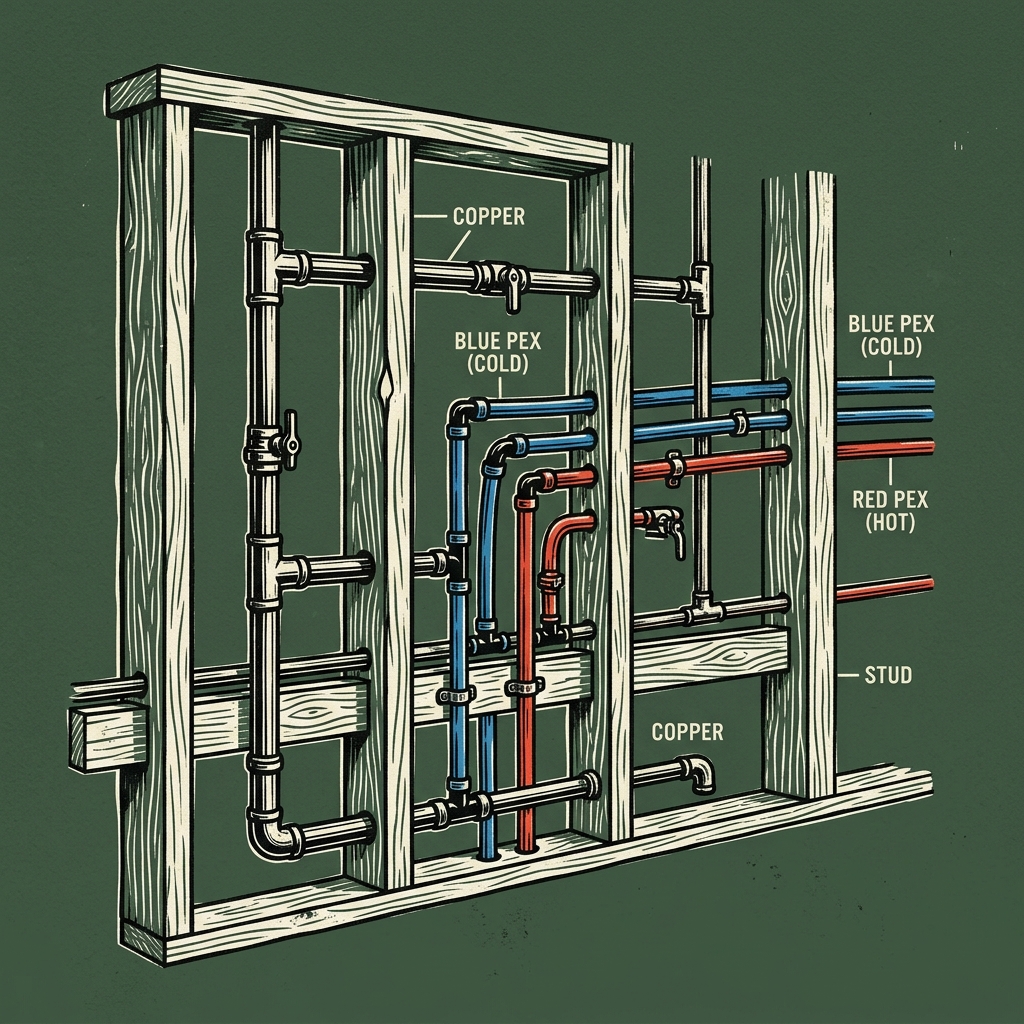
This is one of the few plumbing decisions you make before drywall — and one of the most expensive to reverse after. Copper was the standard for sixty years; PEX has been the production-builder default since the early 2000s. Here’s the honest cost and performance breakdown.
Why the PEX vs Copper Decision Matters More Than It Used To
The choice affects three things you’ll live with for years: rough-in cost, freeze risk, and repairability. PEX-A — the top grade — expands and contracts with temperature, giving it real freeze resistance rigid copper can’t match. That alone has shifted entire cold-climate regions toward PEX as the default.
One overlooked factor: crew familiarity. In regions where plumbers have installed PEX almost exclusively for a decade, an all-copper rough-in means fewer bidders and higher quotes simply because the work is slower and fewer crews want it.
PEX vs Copper: Cost, Installation, and Performance Compared
The clearest way to compare these two materials is side by side, because the differences show up in nearly every category that matters to an owner-builder.
| Feature | PEX | Copper |
|---|---|---|
| Material cost per foot | $0.50–$1.50 | $2–$4 |
| Installation labor | Faster — fewer joints, flexible routing | Slower — requires soldering or press fittings |
| Freeze resistance | High (PEX-A expands without bursting) | Low — prone to splitting |
| Lifespan | 40–50 years | 50+ years |
| UV/sunlight exposure | Degrades — must stay indoors or covered | Unaffected |
For a typical 2,000 sq ft home, total plumbing rough-in cost with PEX usually runs $4,000–$8,000 including labor, compared with $8,000–$14,000 for an all-copper system, according to most 2026 regional plumber quotes. The gap comes almost entirely from labor: a PEX system uses crimp or expansion fittings — including SharkBite connectors for repairs and tight spots — that take a fraction of the time soldered copper joints require. Per IRC P2904, both materials are approved for potable water distribution, so code isn’t the deciding factor for most builds; cost, climate, and crew familiarity usually are.
Regional and Code Variations Worth Knowing
Some jurisdictions still restrict where PEX can run. A handful of municipalities, mostly in older Northeast cities, require copper or CPVC within a certain distance of the water heater or require copper stub-outs at fixtures even when the rest of the system is PEX. Always confirm with your local building department before finalizing your plumbing plan — requirements differ even within the same county.
Climate also drives the decision more than most owner-builders expect. In colder climate zones (5 and above), PEX-A’s expansion capability has made it the practical standard for supply lines run through unheated crawlspaces or exterior walls, since a freeze event that would split copper often leaves PEX-A intact. In hot, sun-exposed regions like the Southwest, copper’s resistance to UV degradation matters more for any exterior runs, since PEX left exposed to direct sunlight degrades within a few years.
Manifold-style PEX systems, which run a dedicated line from a central manifold to each fixture, have also become popular because they isolate problems to a single line instead of an entire branch — useful information when you’re deciding how to lay out your rough-in. A few lenders and insurers in flood- or freeze-prone areas now ask which material was used during underwriting, so it’s worth keeping your rough-in inspection documentation on hand even after the walls are closed.
The Mistake Most Owner-Builders Make
The most common mistake isn’t choosing the wrong material — it’s mixing materials without verifying dielectric unions where copper meets PEX fittings or other metals. Skipping that connection invites galvanic corrosion at the joint, which can cause a slow leak years after your walls are already finished and painted.
A smaller but costly mistake: choosing the cheapest PEX-B tubing instead of PEX-A to save a few hundred dollars on a 2,000 sq ft home. PEX-A’s superior expansion and burst resistance is worth the premium on any run that passes through an exterior wall, attic, or unheated space, where a single freeze failure costs far more than the price difference ever would.
Making the Final Call for Your Build
For most new construction in 2026, PEX is the more practical choice, balancing lower plumbing rough-in cost with strong freeze resistance and faster inspection turnaround. Copper still earns its place on short runs near water heaters or in jurisdictions that require it. Once you’ve settled on your supply line material, the next decision is your drain-waste-vent layout, where the routing rules are stricter and far less forgiving of last-minute changes.
Frequently Asked Questions
Is PEX or copper better for new construction?
PEX is better for most new construction because it costs less to install, resists freeze damage, and goes in faster than soldered copper. Copper still performs well on short, accessible runs, but for whole-house supply lines, PEX-A tubing has become the practical standard among production builders nationwide.
How much does it cost to plumb a house with PEX vs copper?
Plumbing a typical 2,000 sq ft home with PEX runs $4,000–$8,000 including labor, compared with $8,000–$14,000 for an all-copper system. The difference comes mainly from labor time, since PEX uses crimp or push-fit connections instead of soldered joints, cutting installation hours significantly.
Does PEX pipe go bad over time?
PEX has a rated lifespan of 40 to 50 years when installed correctly and kept out of direct sunlight. It degrades faster when exposed to UV light, so any exterior or attic runs need to stay shielded. Properly installed indoor PEX rarely fails before the rest of the home’s systems.
Can you mix PEX and copper pipe in the same house?
Yes, and many builds do exactly that. The key requirement is installing a dielectric union or rated transition fitting anywhere PEX connects to copper or another metal, which prevents galvanic corrosion at the joint. Without that fitting, the connection can corrode and leak years later.
Is SharkBite as reliable as soldered copper?
SharkBite and similar push-fit connectors are code-approved and reliable for both PEX and copper repairs when installed on clean, properly deburred pipe. They’re widely used for repairs and tight access points, though many builders still prefer crimp or expansion fittings for new whole-house rough-in work.